The Norwegian singer and film and theatre composer Sidsel Endresen can touch the emotions of listeners who usually run a mile from abstract improv and experimental electronica.
Now some 30 years into her recording career, Norwegian vocalist Sidsel Endresen remains a singular figure. Never really considered a jazz singer (by herself anyway), for the last few years she's concentrated more on improvisation and extending the potential of her voice as an instrument.
Recent meetings with a younger generation of Nordic musicians – Helge Sten, Christian Wallumrod, Halon Kornstad and Humcrush – have yielded some of the bravest and most beautiful music of her career. And this set with guitarist Stian Westerhus, recorded live in Bergen, is no exception.
Endresen's vocabulary ranges from what you might call "proper" singing to strange, half-spoken phrases, tonal interjections, hums, breaths, gulps, clicks and croaks. There is some kind of unidentifiable language at work, and it's one that carries a hefty but ambiguous emotional punch.
One minute she's sounding like a malfunctioning cyborg, the next a wounded animal or someone in the throes of a psychological meltdown. Then she's sending out long arcs of aching melody worthy of Joni Mitchell at her most obliquely lyrical, or speaking in tongues much as Mary Margaret O'Hara used to.
Using loops, delays, pitch shifters and a whole bunch of jiggery-pokery, Westerhus creates dark, brooding environments for Endresen to inhabit; cavernous bangs, spectral drones, clicks and pops, distant chimes and howls flit through the soundscape. There's not much that passes for conventional guitar playing here. But Westerhus feeds in just enough notes to allow Endresen to work in melodic phrases.
Despite the often brutally dark textures he's a sensitive accompanist, and the empathy between the two is stunning. Wooing the Oracle hinges on a crunching, detuned riff that Endresen uses to deliver a suitably feral outburst that'd have PJ Harvey quaking in her boots. The Law of Oh is a finely crafted essay in spontaneous composition, the pair perfectly attuned in a mournful yet powerful coda; a long cool drink of water after the strong stuff.
If you hadn't guessed, this is not background music. If you're prepared to give it your time and undivided attention, this is an enthralling listen.
Terry Rodgers is an internationally recognized artist who has worked and lived in Massachusetts, Washington, DC, and Ohio.
His first solo European museum exhibition opened May, 2009. In addition, his work has been represented in numerous museum group exhibitions in Europe between 2006 and 2010. In 2007, his work appeared in Art Basel. And in 2005, three of his monumental figurative canvases were presented at the Bienal de Valencia.
Abroad he has had solo exhibitions in galleries in Amsterdam, Brussels, Zurich and Milan, and participated in group shows around the world. He will have upcoming exhibitions in New York and Amsterdam in 2011. In the United States, he has had solo gallery exhibitions in New York, Los Angeles, Atlanta, and Chicago.
European Musea exhibiting his work include the Stedelijk Museum-Hertogenbosch, the Kunsthalle der Hypo-Kulturstiftung in Munich, the Museum Franz Gertsch in Burgdorf, the Museum Folkwang in Essen, the Scheringa Museum of Realist Art in Spanbroek, the Kunsthal Rotterdam, the Kunsthalle Krems in Austria, Kunsthalle Emden in Germany, and me Berlin. Opening in September, his works will be represented in the Helnwein Museum Galerie Rudolfinum in Prague and in the Kunsthalle Rotterdam.
Terry’s most recent book, Terry Rodgers — Dimensions of Ambiguity, was released in 2009. Terry Rodgers — The Apotheosis of Pleasure, was released in 2006. Both books were published by TORCH Books of Amsterdam. Also, Rodgers has been featured in numerous publications in America and abroad including Die Welt, Art in America, Citizen K, German GQ, Kunstbeeld, Arte, Art and FLAUNT to name a few. His works can also be followed widely in blogs internationally.
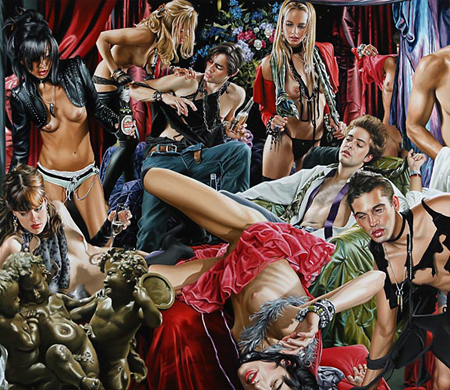
Rodgers’ current work focuses on portraying contemporary body politics. His rendering of an imaginary leisure life stands as an iconic vision of the tensions and confusions endemic to today’s society. These images are not snapshots or slices of life, but rather a compression and dissection of our rampant imaginations and mediated influences. The seductive and marvelous glamour of the outer world jars against the vulnerability and delicacy of our inner and private selves.
Terry Rodgers attended Amherst College, with a major in the Fine Arts. His strong interest in film and photography influenced his style in the direction of representational realism in art.
Cutting edge art ... and the figurative is again avant-garde in the paintings by Terry Rodgers... The viewer is at the same time a voyeur and a guest at the party, but an existential calm reigns in the paintings. Rodgers is a master of composition. His strange parties are, despite all their photographic qualities, put together like a painting by Rubens.
...There is also a troubled insouciance in his characters despite the appearance of living out a seeming fantasy – the clothes, the looks and lounging in the midst of a quasi-orgy fest – there is something fragile and complex about his characters..
Oliver Deuce, a successful doctor, is shattered when his wife is killed in a freak car accident involving the car being driven by Alba Bewick colliding with a very large rare bird. His twin brother Oswald is researching how carcasses decay at the local zoo. Alba survives the accident although she loses one leg, and her sinister physician eventually removes the other 'because it looked so sad all alone'. Oswald and Oliver become involved in a menage a trois with Alba, and uncover very dubious trafficking in zoo property. But ultimately their only goal is to try and understand their mortal condition.
Daphne Oram (31 December 1925 – 5 January 2003) was a British composer and electronic musician. She was the creator of the "Oramics" technique for creating electronic sounds.
Educated at Sherborne School For Girls, Oram was, from an early age, taught piano and organ as well as musical composition. In 1942 she was offered a place at the Royal College of Music but instead took up a position as a Junior Studio Engineer and "music balancer" at the BBC. During this period she became aware of developments in "synthetic" sound and began experimenting with tape recorders. She also spent some time in the 1940s composing music, which remained unperformed, including an orchestal work entitled Still Point. In the 1950s she was promoted to become a music studio manager and, following a trip to the RTF studios in Paris, began to campaign for the BBC to provide electronic music facilities for composing sounds and music, using electronic music and musique concrète techniques, for use in its programming. In 1957 she was commissioned to compose music for the play Amphitryon 38. Using a sine wave oscillator, an early tape recorder and some self-designed filters, she produced the score from only electronic sources; the first of its kind at the BBC. Along with fellow electronic musician and BBC colleague Desmond Briscoe, she began to receive commissions for many other works - including a significant production of Samuel Beckett’s All That Fall. As demand grew for these electronic sounds, the BBC gave Oram and Briscoe a budget to establish the BBC Radiophonic Workshop in early 1958, where she was the first Studio Manager. In October of that year, she was sent by the BBC to the "Journées Internationales de Musique Expérimentale" at the Brussels World’s Fair (where Edgard Varèse demonstrated his Poème électronique). After hearing some of the work produced by her contemporaries and being unhappy at the BBC's music department's lack of interest, she decided to resign from the BBC less than one year after the workshop was opened, hoping to develop her techniques further on her own.
In 1959 she installed her Oramics Studios for Electronic Composition in Tower Folly, a converted oast house at Fairseat, near Wrotham, Kent. Her output from the studio, mostly commercial, covered a far wider range than the Radiophonic Workshop, providing background music for not only radio and television but also theatre and short commercial films. She was also commissioned to provide sounds for installations and exhibitions. Other work from this studio included electronic sounds for Jack Clayton's 1961 horror film The Innocents, concert works including Four Aspects and collaborations with opera composer Thea Musgrave and Ivor Walsworth.
Oramics machine displayed at the Science Museum, London (2011)
In February 1962, she was awarded a grant of £3550 from the Gulbenkian Foundation to support the developments and research of her "Oramics" drawn sound technique. This method of music composition and performance was intended by Oram to allow a composer to be able to draw an "alphabet of symbols" on paper and feed it through a machine that would, in turn, produce the relevant sounds on magnetic tape. A second Gulbenkian grant of £1000, awarded in 1965, enabled the Oramics composition machine to be completed. The first drawn sound composition using the machine, entitled "Contrasts Essonic", was recorded in 1968.
Throughout her career she lectured on electronic music and studio techniques. In 1971 she wrote An Individual Note of Music, Sound and Electronics which investigated electronic music in a philosophical manner. Besides being a musical innovator her other significant achievements include being the first woman to direct an electronic music studio, the first woman to set up a personal studio and the first woman to design and construct an electronic musical instrument.
In the 1990s she suffered two strokes and was forced to stop working, later moving to a nursing home. She died in 2003, aged 77. After her death a large archive relating to her life's work was passed to the composer Hugh Davies. When Davies died in 2005 this material passed to Sonic Arts Network. Daphne Oram's family have now agreed that the archive will reside at the Music Department of Goldsmiths College in London where it will be[old info] made open for public access and ongoing research from February 2008 onward. In June 2008, a series of concerts and symposium at the Southbank Centre was held to celebrate the launch of the archive. This included a concert of newly reworked versions of material from the collection by music collage artist People Like Us.
In 2007, a compilation of her music, entitled Oramics, was released.
Demdike Stare is having a moment. This UK duo whips up a very en vogue blend of dank, dark ambiance and distant, decimated techno. They’ve been going steady since 2009, and not just as a unit. In fact, I’m pretty sure I like the 2010 debut release from Miles Whittaker’s side project Suum Cuique more than anything Demdike put out that year. Only six tracks, but it’s a hell of an album. Gaping chasms of synthetic nothingness, hellish circuit-breaking and soundwave-bending transmissions from a dusty abandoned archive beneath the BBC Radiophonic Workshop, that sort of thing. It’s all very Eleh, admirably minimalist yet actually engaging.
If memory serves, the person behind Suum Cuique was originally unknown. Regardless of whether this was actually true or Boomkat was just bullshitting us again, the debut did have an undeniable air of anonymity. It didn’t sound like it wanted to be found out. It sounded like the kind of thing recorded in disbelief on some long-lost cassette player and whispered about for a while as a plausible enough Soviet urban legend until finally being debunked by Snopes, not a ZIP file sent to some underground label head’s attention.
So now, two years and two Pitchfork reviews later, Whittaker has delivered his followup Suum Cuique statement, Ascetic Ideals. There’s something unsettling about the album’s presentation, namely the unexpectedly weighty title coupled with the unadorned shot of what looks like a unanimously feminine yet strikingly unsexualized group of trainees at some early 90s call center. Is inscrutability the new anonymity? Was there ever a difference?
The music is just as staunchly analog and desolate this time around, but there’s also a vivacious malevolence simmering behind all the noise. “Kuiper Anomaly” most clearly recalls Whittaker’s minimal techno background but slows down the rhythm to veritably glacial levels. “Core Value” is a different kind of downtempo whose beats sound like underwater gunshots. “Atlas Levels” is downright otherworldly, a creature from the fiery lagoon attempting to communicate through a sore throat. And closer “Dionysus Decay” is palpably angrier than anything we’ve heard from Suum Cuique before.
Ascetic Ideals isn’t nearly as effortless as its predecessor; these sounds feel self-consciously arranged in a way they simply didn’t last time, perhaps an inevitable result of being put together during the recording process for the big ol’ Demdike Elemental album (which we reviewed earlier this year). Regardless, Whittaker knows his synth-drone-noise-whatever, so if you’re into this sort of thing—or if you ever wished you could do shrooms with Eliane Radigue—then you’ll find plenty to enjoy here.